
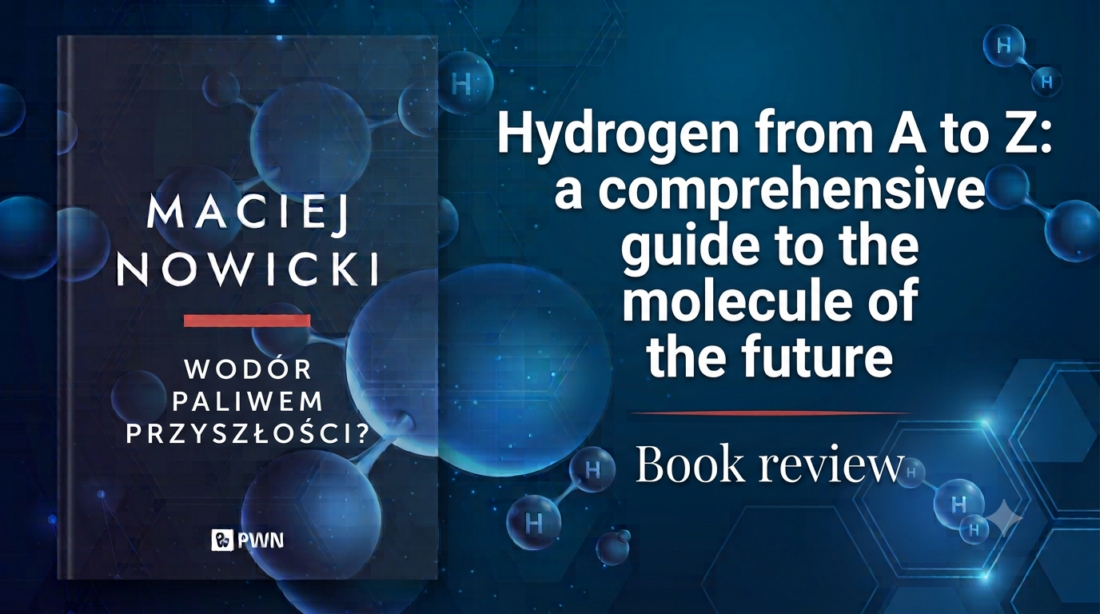
Hydrogen from A to Z: A Comprehensive guide to the molecule of the future
My fascination with chemistry dates back to my earliest years, when I eagerly immersed myself in advanced literature and academic textbooks. I hold a particular affection for works published back in the 1960s and 70s. Those texts strongly emphasized the unique role of the hydrogen atom, viewing it not merely as a reference point for atomic weights or valencies, but virtually as the philosophical and practical bedrock upon which the entire field of chemistry was built. Today, working in a highly specialized, multifaceted intersection of chemistry and safety compliance, I find myself revisiting hydrogen from an entirely new perspective.
It was with great curiosity, then, that I picked up Prof. Maciej Nowicki’s latest work, “Hydrogen as the fuel of the future?”, published by PWN Scientific Publishers. The book is remarkable on many levels, but its greatest strength lies in its exceptional interdisciplinary scope. The author has crafted a masterfully cohesive narrative that spans nearly every facet of the hydrogen value chain, from basic physicochemical principles and production routes including the full spectrum of green, blue, and grey hydrogen to global geopolitics, EU strategies, and the evolving Polish regulatory framework, alongside contemporary socio economic frameworks.
Crucially, despite the vast wealth of knowledge and technical complexity involved, the book remains exceptionally accessible. Prof. Nowicki delivers high level science with a lucid, engaging touch, making the reading experience genuinely enjoyable. A striking case in point is his use of quantitative examples that instantly illuminate the scale of the ongoing energy transition. Particularly memorable is his economic analysis of hydrogen powered transport, illustrated via the Toyota Mirai II. As the author demonstrates, should green hydrogen production costs drop to the projected 1.50 dollars per kilogram, the fuel cost for driving 100 km could drop to as little as 6 to 7 PLN. Framed this way, the economic viability of hydrogen mobility suddenly comes into sharp, compelling focus.
Given my professional background, I naturally paid special attention to the chapter dedicated to hydrogen storage and transport. High pressure compression, cryogenic liquefaction, and pipeline transmission are subjects that are inherently complex and can easily intimidate non specialists. Yet, Prof. Nowicki possesses a rare talent for demystifying intricate engineering concepts. He guides the reader through the evolution of pressure vessels and logistical challenges in an approachable, stress free manner, building technical literacy without burying the audience in dense, esoteric jargon.
Ultimately, this is an extraordinarily comprehensive and versatile work with something to offer everyone. Lay readers will gain a clear, multidimensional overview of the energy transition, economists and executives will find a wealth of market forecasts and cost dynamics, while EHS and HAZMAT professionals receive a remarkably structured synthesis of safety engineering. In short, this book serves as an indispensable bridge between theoretical science and industrial application, one I wholeheartedly recommend to anyone invested in the future of energy.
This review copy was kindly provided as part of a collaboration with PWN Scientific Publishers.
The graphic for this post was generated using AI tools. The book cover image comes from: PWN.